






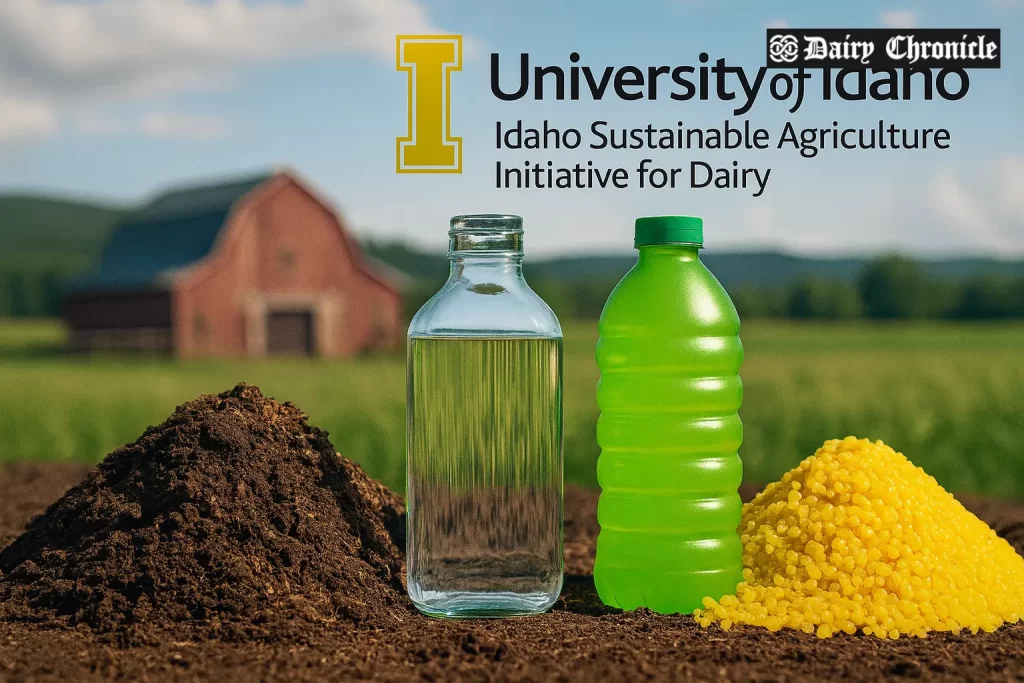
The dairy sector in Idaho is turning its waste into valuable products, going from manure to fertilizer, clean water, and bioplastics, for a great return of the farm.
Dairy Manure Turns Waste into Profit
The U.S., particularly Idaho, is experiencing a revolutionary transformation in dairy waste management as Idaho dairy manure is being changed into valuable products like fertilizers, clean water, and biodegradable plastics. This progress, driven by the Idaho Sustainable Agriculture Initiative for Dairy (ISAID) in collaboration with USDA’s National Institute of Food and Agriculture (NIFA), is establishing Idaho as a leader in sustainable dairy practices.
Starting from 2020, the ISAID project has been using a $10-million USDA grant in order to develop and commercialize the technology that converts waste and water from cows into products, that at the same time, improve farm productivity and protect the environment, and Idaho now being the third-largest state in the U.S. dairy production, it has become a vital issue of how to handle large volumes of waste. The creative approaches of ISAID show that there is no need to choose between ecological and financial solutions for dairy farmers.
Fertilizer from manure
The development of enriched biochar, a slow-release fertilizer solely formed by the process of trapping nitrogen and phosphorus from lagoon water as well as from post-digester liquid, is one of the key breakthroughs. Graduate student Samantha Clark at the University of Idaho has spearheaded the greenhouse testing, proving that crops grown with the help of enriched biochar show similar results with those grown with traditional fertilizers under both normal and water-limited conditions.
The mobile units that are going to be commissioned this fall will be used on farms for the initial production of enriched biochar. Besides, field trials of considerable size are also planned for next year’s growing season. Such a way of production, in addition to significant cost savings for fertilizers, makes it possible to cut down nutrient runoff, which has lately been an environmental problem in the area of manure management.
Hydrochar: Capturing Phosphorus
Phosphorus-rich manure is first passed through hydrothermal carbonization to make hydrochar, a stable soil amendment. Dr. Brian Hess’ team at the University of Idaho has developed lab-scale reactors that are capable of trapping up to 90% of phosphorus, thus decreasing the risk of water pollution and providing farmers with a renewable source of fertilizer. They are currently working on continuous-flow reactors for farm-scale production and are conducting a full cost-benefit analysis to determine the commercial viability of this process.
Bioplastics from Manure
In a major technological advancement, the process of converting Idaho dairy manure into biodegradable plastics is underway. It consists of a three-stage fermentation process carried out by Dr. Erik Coats. The bacteria in the manure multiply rapidly (over 60%) as they consume the volatile fatty acids and at the same time generate polyhydroxyalkanoates (PHA). The resulting bioplastic can be modified to create either rigid packaging or flexible film and thus be a viable, more environmentally friendly alternative to the use of fossil-based plastics, while at the same time, we are solving the phosphorus problem in the fertilizer industry.
Clean Water Recovery
ISAID has built a clean water machine as a solution to effluent-laden waste removal. The system can reclaim water for irrigation of up to 80% of the consumed volume by using sedimentation, membrane filtration, and chemical processes. Moreover, it has been demonstrated that watering can be a sustainable method besides being cost-efficient with the help of the local recycling program. In addition to cutting expenses, authorizing water reuse with the help of the local recycling program, the circular bioeconomy will also be able to take care of the local waterways. In the words of Extension engineer Lisa Martinez,
Towards a Circular Dairy Bioeconomy
They developed through the introduction of new technology and sustainable-yield approaches to the agriculture sector, they led the way for the creation of a circular dairy bioeconomy in Idaho, whereby waste from the dairy industry becomes a new source of income. Possibility of such a venture stirs farmers’ imaginations; they could not only produce milk but at the same time sell enriched biochar, hydrochar fertilizers, bioplastics and reuse water, thus financially gaining from a new avenue of farm operations sustainability. In the opinion of Jason Winfree, Ph.D., University of Idaho agricultural economist, technologies could transition the profit and the environmental footprint of family farms to a “nearly opposite” spectrum.
Farmers Ready to Adopt
Farmers on the ground are willing and capable to put these tech solutions into practice. The study, in his view, “a change of the game,” said Hank DeVries, a third-generation dairy farmer, emphasizing the project being the main source of the waste-to-resource potential as the best advantage it could have. Moreover, Jason Nunes, co-owner of Sunnyside Dairy, in a similar manner, shifted the spotlight on the environmental and economic gains brought about by viewing waste as a renewable energy source that could lead the way for the innovators.
Training and Outreach
ISAID has rolled out several educational programs which include bulletins, web tutorials, and a podcast, “The Clever Cow,” for farmers who are willing to find out and apply the changes. The conference “Waste to Worth” (held in Boise, spring of 2025) displayed the research results, and was very effective in inviting interaction among producers, engineers, economists, and regulators. Besides that, with on-farm trials, economic modeling, and environmental monitoring all in progress, ISAID is still involved in supporting farmers in making the right adoption decisions for 2025.
FAQ’s
How is dairy manure turned into useful products?
Dairy manure can be converted into fertilizers, clean water, and even bioplastics using advanced processes such as biochar production, hydrothermal carbonization, fermentation, and water filtration systems.
What is biochar fertilizer?
Biochar fertilizer is a nutrient-rich soil amendment made by capturing nitrogen and phosphorus from manure lagoon water. It acts as a slow-release fertilizer, reduces nutrient runoff, and provides crop yields comparable to chemical fertilizers.
Can bioplastics really be made from cow manure?
Yes. Through a three-stage fermentation process, bacteria in manure produce polyhydroxyalkanoates (PHA), a biodegradable plastic. These bioplastics can be used for rigid packaging or flexible films, helping reduce reliance on fossil-based plastics.
How is clean water recovered from manure?
Clean water is recovered from manure using sedimentation, membrane filtration, and chemical treatment systems. These processes reclaim up to 80% of water from manure effluent, making it reusable for farm irrigation.
How is phosphorus recovered from manure?
Phosphorus is recovered from manure through hydrothermal carbonization, which converts it into hydrochar, a stable soil amendment. This process traps up to 90% of phosphorus, preventing water pollution and creating a renewable fertilizer source.
What is a circular dairy bioeconomy?
A circular dairy bioeconomy is a system where dairy waste is turned into valuable products such as fertilizers, bioplastics, and clean water. This approach helps farmers reduce waste, cut input costs, and gain new income streams, while also protecting the environment.
READ MORE ON


