


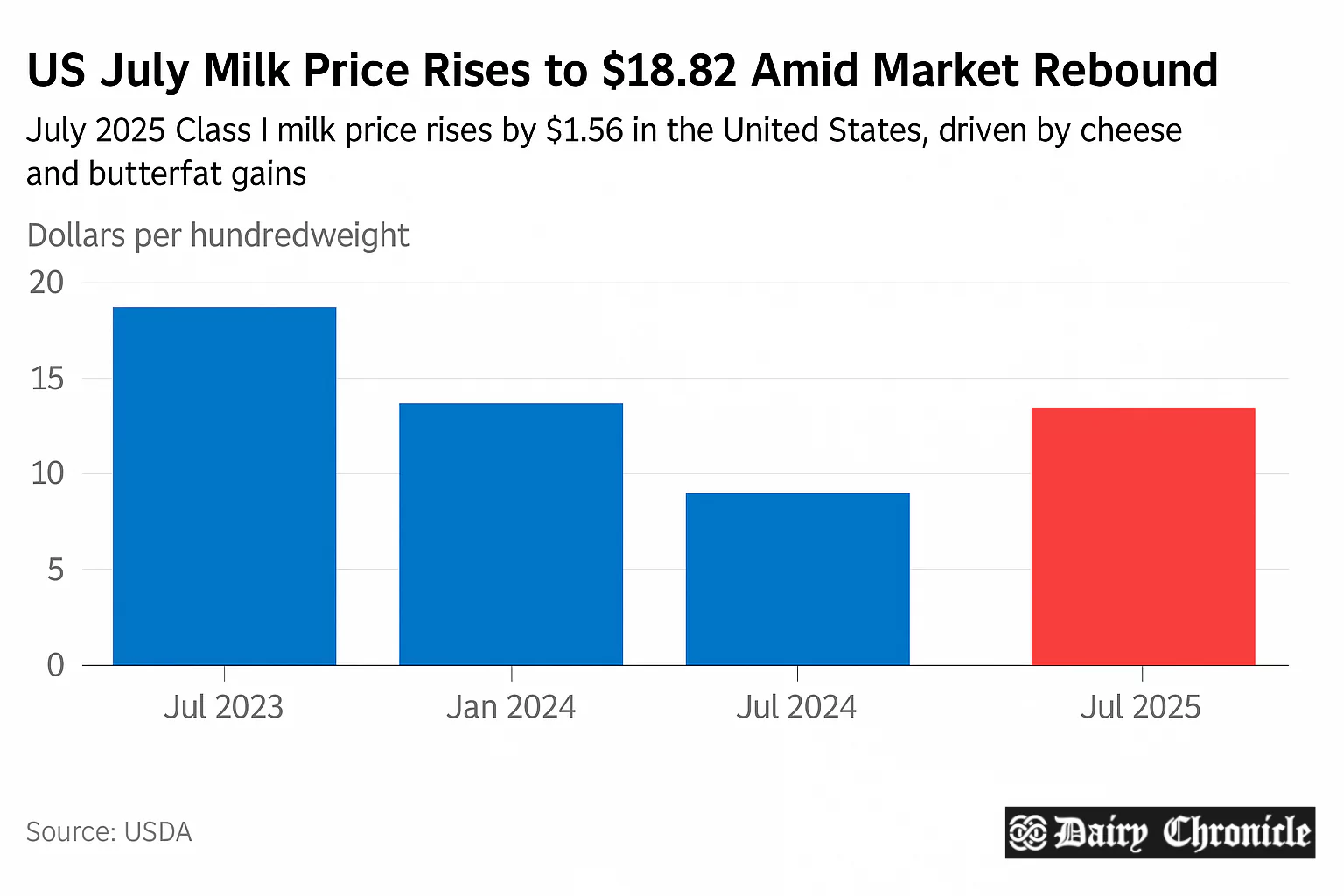
The United States Department of Agriculture (USDA) has announced that the Class I milk price for July 2025 has increased to $18.82 per hundredweight, up by $1.56 from June’s level. This update, under the Federal Milk Marketing Order (FMMO) system, reflects gains in the Class III cheese market and stronger butterfat values. Despite the rise, prices remain below July 2023 levels, indicating a partial recovery in a volatile dairy market.
The United States Department of Agriculture (USDA) has announced a significant rise in the Class I milk price for July 2025, setting the advanced base price at $18.82 per hundredweight (cwt). This represents a $1.56 increase from June’s figure under the Federal Milk Marketing Order (FMMO) system. The USDA is responsible for ensuring the pricing and regulation of milk under the FMMO framework to support both producers and consumers across the U.S.
While this rebound indicates growing strength in the dairy market, particularly in Class III pricing—influenced by strong cheese market performance—and improved butterfat values, the July figure still lags $2.29 per cwt behind July 2023’s price. This signals only a partial recovery from recent market volatility that has impacted dairy producers nationwide.
The pricing is based on the “higher-of” formula, where the higher of Class III or Class IV milk pricing factors determines the Class I base. For July, the Class III factor, set at $9.66 per cwt, surpassed Class IV, making it the key mover.
When regional differentials are factored in, actual Class I prices across the 11 FMMO regions will average around $20.12 per cwt. The highest price is expected in the Appalachian region at $21.02 per cwt, while Arizona will see the lowest, at $19.07 per cwt.
The USDA’s pricing update comes at a time when producers are closely monitoring input costs and forward contracting opportunities amid shifting dynamics in skim milk and butterfat markets.
With the dairy industry continuing to adapt to evolving market trends and pricing pressures, this rebound may offer some short-term relief while highlighting the need for long-term strategies in milk production and marketing.