


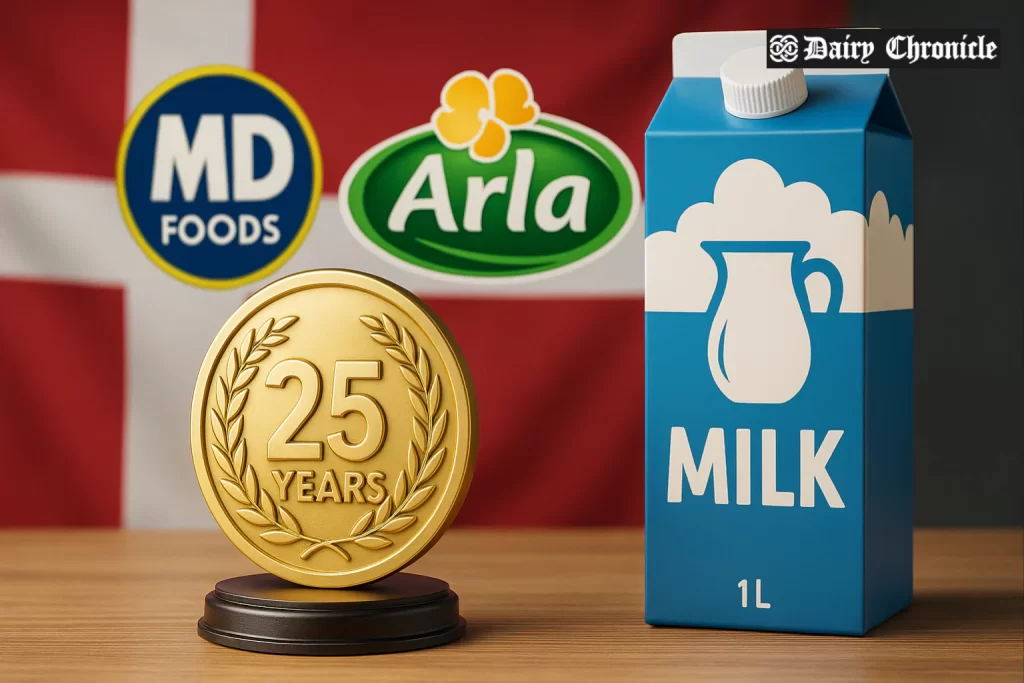
Located in Denmark, Arla Foods marks 25 years since the joining of Arla and MD Foods with a report that is financially reassuring for the year 2025, despite the volatile international environment.
In Denmark, Arla Foods is commemorating 25 years since the merger between the Swedish cooperative Arla and the Danish cooperative MD Foods, which combined a farmer-owned multinational dairy giant into the world’s best. Despite the turbulent market in 2025, the company manages to provide positive financial results, thereby illustrating the strength of its cooperative model.
Strong 2025 Results Amid Market Pressures
The first half of 2025 saw Arla Foods posting a net profit of €158 million and revenues of €7.5 billion. The cooperative maintained a performance price of 57.5c/kg. According to CEO Peder Tuborgh, this is a result that points to the strength of the farmer-owned cooperative structure, which in turn reflects the commitment of both farmer-owners and employees.
Branded products were sold in smaller volumes with a 1.5% decline, which was due to the high price of dairy commodities and the unstable geopolitical situation.While the ingredients business exceeded expectations to realize its planned outcomes. The main driver of this positive turnaround was the acquisition of Volac Whey Nutrition, through which Arla deepened its nutrition-focused portfolio.
The Strength of the Cooperative Model
Arla’s creation through the 1999 MD merger was, in effect, a new idea; it connected Sweden’s Arla and Denmark’s MD into a cooperative that would be stronger on the international market and greener by design. The farmers-owned model has allowed Arla in these 25 years to turn dividends into innovations, efficiencies and farmers sustainability programmes.
CEO Peder Tuborgh stated that cooperative robustness is one of the most important things that enable it to survive variations in the whole world. While the company is fiercely competing to give good prices for milk to the farmers, it is also implementing some measures that will preserve its sustainability.
Future Investment Plans
For the year 2025, Arla Foods has some plans to make an investment worth between €650m and €700m (excluding mergers and acquisitions). The company is committed to taking these investments in order to increase the production capacity, supply chain stability, and food security in the area of climate change and geopolitical crisis.
One of the most important factors to ensure that the good results are kept, is to reinvest in the infrastructure area. Moreover, this will allow the farmer-owners to receive the greatest value for their money, and the food supply to the international markets to be stable, which is what Arla plans to achieve in the long term.
Also Read: Arla Foods Invests €50.9M in Bahrain to Boost Cheese Output
Market Volatility and the Turning Points of the Company’s Strategy
The global dairy market keeps going through the turbulent times of ever-increasing production costs, rapidly changing consumers preferences, and intense competition.
In order to overcome these barriers, the arrogant strategy of Arla consists of:
- Advancing its ingredients and nutrition division, which has been the highest in the last year with a growth rate of more than 20%.
- Using different strategies such as consumer-focused and premiumization in order to face the volume decline of branded products.
- Moreover, these strategies are the perfect ways of guaranteeing that Arla keeps the stability and the long-term growth that she is looking for.
Arla’s Global Footprint and Growth Path
Danish-based Arla Foods is a large European dairy cooperative with subsidiaries in both the Old World and the Asian region and the American continent. Its cooperative paradigm is still differentiating it from investor-owned competitors and keeps it safe from reinvestment and farmer conflict.
On the occasion of the merger, Arla is giving emphasis on its pledge on the equilibrium of the farmer’s value, innovation, and market responsiveness. The company’s combined dairy, nutrition, and ingredients portfolio places it in a robust condition despite the global uncertainties.
FAQ’s
Q1. What is the significance of Arla Foods’ 25-year merger?
One of the most significant events that have had a positive impact on the development of agriculture in Europe is the merging of Arla and MD Foods in 1999. With this cross-border cooperative, the company went beyond farmer-owned operations in Europe to even more extensive operations globally.
Q2. How did Arla Foods perform financially in 2025?
Arla achieved a net profit of €158 million in the first half of 2025, and the turnover totaled €7.5 billion. The upbeat performance was mainly due to the success of the ingredients unit.
Q3. What future plans has Arla Foods announced?
Arla is planning to spend between 2025 €650 and €700 million to expand the production of food, thus ensuring safety and an everlasting supply of food.
READ MORE ON
7 Comments
mzp8qa
xchbmo
3g94av
q5x9cg
rti2bf
7cwnps
yhh3ee