


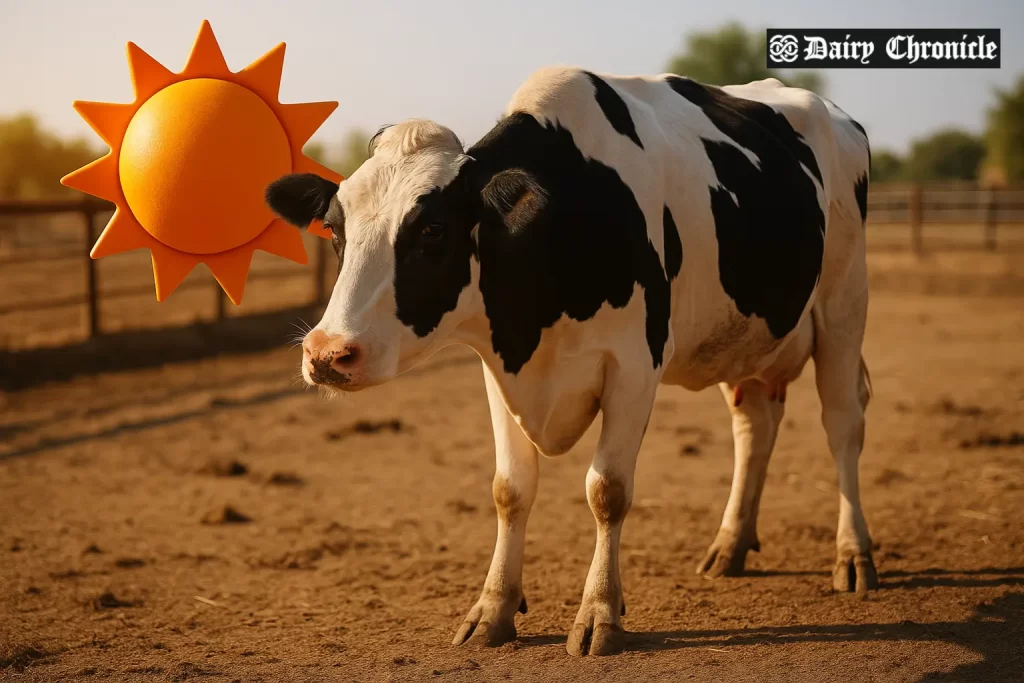
Recently a study in the Netherlands has shown that heat stress in dairy cows has an impact on the rate of conception and the calving intervals elongate, thus the productivity of the herd and breeding strategies become problematic.
Heat Stress in Dairy Cows 2025
For the Netherlands this has been an exemplary moment. Scientific researchers are uncovering new facts about Dairy Heat Stress and how it has a negative impact on the fertility of cows.
The analysis published in the Journal of Dairy Science turned out to be the one where researchers met over 416,000 first-parity Holstein cows data and correlated a temperature-humidity index (THI) to reproductive performance. What is more, the studies findings cause a chain reaction of implications for us in terms of the global dairy farming efficiency, herd management, and future breeding strategies.
Rising Temperatures and Dairy Fertility
Heat stress in dairy cows is becoming a main problem of the modern dairy farm that needs urgent solutions. In Holland where Holstein cattle are the main high milk producers of the dairy sector, the rise in temperature and humidity has already started to affect the basic fertility traits. In the paper, the following fertility traits were identified and assessed:
- Conception rate
- Interval from calving to first insemination
- Interval from first to last insemination
- Calving interval
The researchers adopting the temperature-humidity index (THI) approach discovered the several points where the impairment of reproductive efficiency due to heat started, are such that making a diagnosis of the disorder based on the symptoms might not be easy.
The Temperature-Humidity Index Threshold
Scientists discovered that the temperature-humidity index (THI) threshold beyond which the reproductive system suffers varies with the specific trait. For conception rate and interval from first to last insemination the threshold was 60, while for calving to first insemination and calving interval the threshold was 50.
Moreover, these were the consequences when the THI surpassed the set points: the rates of conception experienced a steep decline, the length of the episode between the attempts of insemination was extended along with the time from calving. For dairy farms in the Netherlands and far beyond herein lie the economic consequences: the costs per cow increase, the cycles of milk production become delayed, and the long-term profitability gets cut down.
Also Read: Heat vs. Milk: A New Weapon Emerges in Dairy’s Fight
Genetic Variation and Future Breeding Potential
The Dutch study points out the presence of the genetic variation in different cows’ reactions to the same heat conditions as one of the major convers. It is thus stressed that a heat stress in cows can not be eradicated by a rising global temperature but a selective breeding program can be the solution to producing animals that are more heat-resilient.
Imagine how breeding programs that are backed by this science of genetic variation could:
- Help improve conception rates under heat stress situations.
- Drive down the interval from calving to insemination.
- Keep the calving interval stable even when temperature changes.
Such gene technologies are a long term solution till which we stabilize fertility traits and at the same time, herd productivity be maintained.
Economic Implications for the Dairy Sector
Heat stress in dairy cows is a major source of concern to the whole milk industry from the economic point of view. Low fertility is a direct cause of lower milk production, higher veterinary and breeding costs, and longer periods of time before the animal starts yielding profitability again.
What the Dutch have discovered is very pertinent to any country in the world that has a summer of increasing average temperatures. According to the researchers, milk farms there could face the rise of their costs by 5–15%, just because the reproductive efficiency of the animals disturbed. It also means that, on one hand, dairy farmers’ profits will get squeezed, and on the other hand, there could be milk price hikes in the market and supply chain disruptions.
Global Lessons for Dairy Farmers
The lessons the Dutch learned and shared have a global reach and timing. Such milk producing areas as India, the United States, and Southern Europe, are already experiencing fertility problems caused by heat stress in dairy cows. Investing in the following areas is crucial according to the study:
- Advanced cooling systems in barns
- Optimized feeding strategies for heat resilience
- Genetic selection programs to identify resistant herds
- Digital monitoring tools that track THI in real time
These countries that put the heat stress issues under control and act soon would be in a position to enjoy stable milk production and maintain their positions in the global dairy market.
Expert Commentary
Economists and veterinarians alike acknowledge that the effects of heat due to climate change are inevitable but mitigate through data-supported policy choices and innovation. The discovery is consistent with the call for more concerted efforts between gene research, farmer training, and public support for coping with the climate.
It comes as a perfect confirmation that, although the position of the Netherlands as one of Europe’s major dairy-export will not be affected overnight, such a scenario should not be allowed to develop.
Future Outlook
In the future, genetic resistance, and the use of modern technologies will be the major factors defining how dairy farming will cope up with changing climate conditions. The study of the Netherlands highlights that heat stress is not only a health problem but also a financial and strategic problem for the whole dairy industry.
As weather gets more and more extreme, both policymakers and the industry leadership will have to be ready to implement immediate measures (e.g. barn cooling and THI monitoring) as well as undertake ambitious planning for long-term genetic solutions so as to secure milk production.
FAQ’s
How long heat stress lasts in dairy cows?
Heat stress in dairy cows can last for several days or weeks during periods of sustained high temperatures, depending on local climate conditions and housing systems.
Does heat stress in dairy cows affect feed intake?
Yes, heat stress in dairy cows often leads to reduced feed intake as cows consume less to minimize internal heat production, which can affect overall body condition.
Can heat stress in dairy cows be prevented?
While it cannot be fully prevented, heat stress in dairy cows can be managed with cooling systems, shaded areas, and improved ventilation to reduce the severity.
Do calves get affected by heat stress in their mothers?
Indirectly, yes. Heat stress in dairy cows can reduce milk yield and quality, which may impact the nutrition and growth of calves.
Can monitoring help beat heat stress in dairy cows?
Monitoring temperature-humidity levels helps farmers take timely action against heat stress in dairy cows, preventing production losses and health complications.
READ MORE ON