


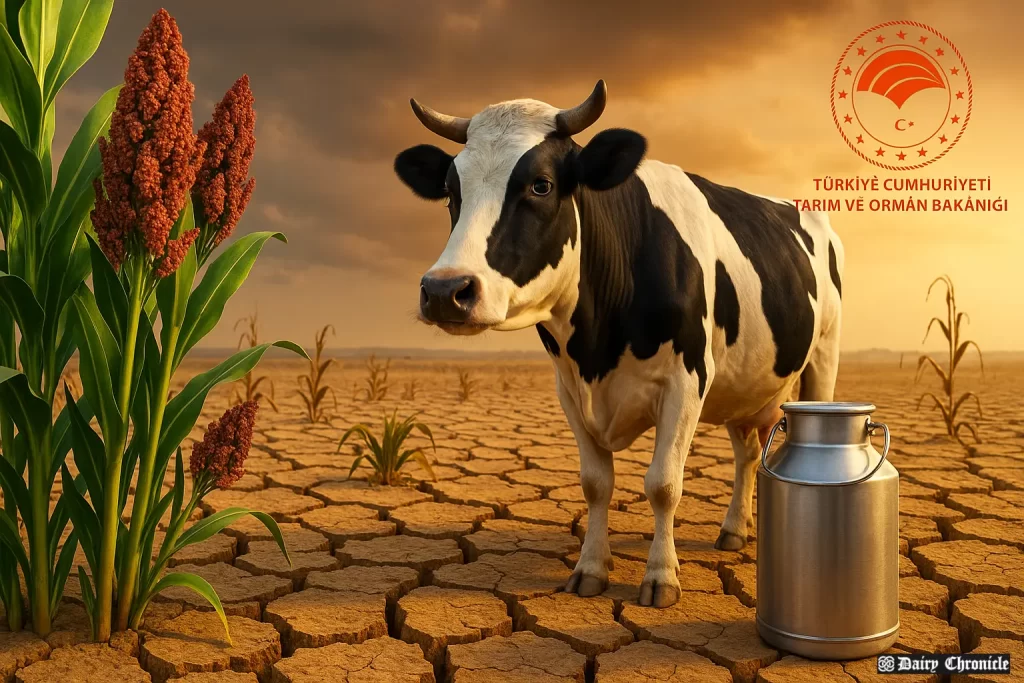
The Izmir dairy farmers, facing one of the worst droughts in years, are choosing sorghum, a drought-resistant crop, instead of corn silage. This change allows water-saving while keeping the feed supply for the livestock and the productivity of the dairy sector safe.
Dairy Industry of Turkey at a Crossroad
The Ministry of Agriculture and Forestry in Turkey, situated in Ankara, is the agency responsible for the country’s agriculture and dairy sector, the two largest contributors to rural employment and food security. While dairy activities are predominantly carried out in Izmir, the Aegean province has been at the forefront of milk production in the country for the last three years. Nevertheless, due to the current water crisis, the region has been compelled to undergo structural change, thus changing the types of crops and the feed strategy of the farmers.
Turkish Dairy Farmers Choose Sorghum
As a result of the drought, the farmers in Izmir have decided to abandon the usual silage of corn and turn to the drought-resistant sorghum. Earlier, the region consumed 3.45 million tons of corn silage grown over 550,000 acres and allowed feeding for 480,000 dairy cattle and small ruminants.
Growing corn usually needs seven to eight waterings, which is a hard strain on water resources. On the other hand, sorghum can produce the same amount with only two to three times watering, and thus it is a water-saving crop. Farmers are thinking that sorghum guarantees the survival of the herd and the productivity of the dairy sector in the long run.
Fast Growth of Sorghum Cultivation
Over the last five years, the adoption of sorghum has gained a lot of momentum.
- The year 2020 saw the number of farmers who planted sorghum only on 451 acres was 28.
- The year 2025 witnessed the number of farmers growing sorghum almost reach 6,000 acres, reaching 337.
The transition is supported with a 75% seed subsidy granted by the Ministry of Agriculture and Forestry, which enables the farmers to move comfortably from corn to sorghum. The financial help facilitates the change of cultivation pattern and allows the dairy sector to remain stable amid climate-related obstacles.
Water Crisis Getting Worse in the Aegean
Izmir’s water problem is also a symptom of the crisis in the entire western part of Turkey. The precipitation in the first eight months of 2025 was 27% that of the previous year. Both winter and summer harvests got impacted. The water levels of the dams are decreasing, and there are some that are almost empty (less than 1%). Therefore, Çeşme has been experiencing water shortages to the extent that the administration had to introduce 10-hour water cuts per day. These cuts start at 12 a.m. and finish at 10 a.m.
The first sector to suffer is agriculture. Mustafa Sahin, Director of Provincial Agriculture and Forestry, pointed out that water planning should really rely on the water that is available. He stated that the effects of global warming would be undeniable and called upon both urban and rural communities to try their best to use water efficiently.
The Financial and Operational Impact of the Farmer
Sorghum replacement has a serious financial impact:
- Reduction in Irrigation Costs: Smaller energy and labor costs come from fewer irrigation cycles.
- Stable Dairy Production: Sorghum can be nutritionally equal to corn, and thus milk and meat production can be maintained.
- Risk Reduction Strategy: The use of water-efficient crops decreases the risk of droughts in the future.
For dairy producers, these moves mean that even if the rainfall is not predictable, they can still count on their income to be stable. Farmer by sorghum use keeps both herd health and pastoral chain profitability stable in the supply chain.
Voices from the Farming Community
Local dairy farmers are already seeing the advantages of this transformation. Zafer Yurt, a dairy farmer of Menemen district’s Hasanlar village, declared that he has planted sorghum on 45 acres of his land. According to him, the grass was equally effective with corn for milk and meat production; in addition, they were able to save a great amount of water.
“The drought is all over Turkiye; therefore, we want to save water,” he said, pointing out that most large farmers have already made their decision to use sorghum. To say the least, that trend is echoed not only in the dairy sector but also among crop producers in and around Izmir where farmers have realized that the change in the weather of even more extremity is not only a challenge that they have to face but also a problem that they have to solve by changing the way they grow
Modern Irrigation and Long-Term Sustainability
Almost all farmers in Izmir have, by and large, switched over to the modern types of irrigation, such as the drip and pivot, to achieve maximum water use efficiency. As the level of groundwater keeps falling, the authorities argue that combating the use of wasteful irrigation methods is the main issue.
On the other hand, the long-term sustainability of the Turkish dairy sector will be largely dependent on this mix of crop diversification and technological turn. The need for dairy products gaining momentum will ensure that stable feed remains the pivot of both domestic consumption and the export market.
Strategic Outlook for Turkiye’s Dairy Sector
The sorghum adoption is a turning point to the dairy supply sector of Turkiye, signifying a major shift; by the alignment of water availability with agricultural practices, that sector will fortify its climate
Moving forward, the efforts of policymakers and farmers should be centered on:
- Extending seed subsidies for supporting the further adoption of sorghum by farmers.
- Allocating funds for the development of water resources with the aim of stabilizing irrigation systems.
- Developing training programs for farmers that will help them efficiently use modern irrigation methods together with the conservation of soil and water resources.
If these actions materialize, the imbalance between productivity and sustainability, which is currently a problem for the dairy sector in Turkey, can be overcome, and that sector can even have its food security and financial stability guaranteed in the long term.
FAQ’s
Why are Turkish dairy farmers switching from corn to sorghum feed?
Due to severe drought conditions, farmers in Izmir are shifting from water-intensive corn silage to drought-resistant sorghum, which requires far less irrigation while ensuring adequate nutrition for dairy cattle.
How much water does sorghum save compared to corn?
Corn silage typically requires seven to eight waterings, while sorghum can achieve similar yields with only two to three waterings, making it a significantly more water-efficient crop.
How will sorghum adoption impact Turkey’s dairy sector?
By reducing dependence on water-heavy corn, sorghum helps secure feed supply, protect livestock productivity, and sustain rural dairy farming during water crises. This shift also supports long-term food security and farmer resilience.
What role does Izmir play in Turkey’s dairy industry?
Izmir, in the Aegean region, has been the leading milk-producing province in Turkey for the past three years, making its adoption of sorghum a potential model for other dairy regions facing similar challenges.
READ MORE ON