


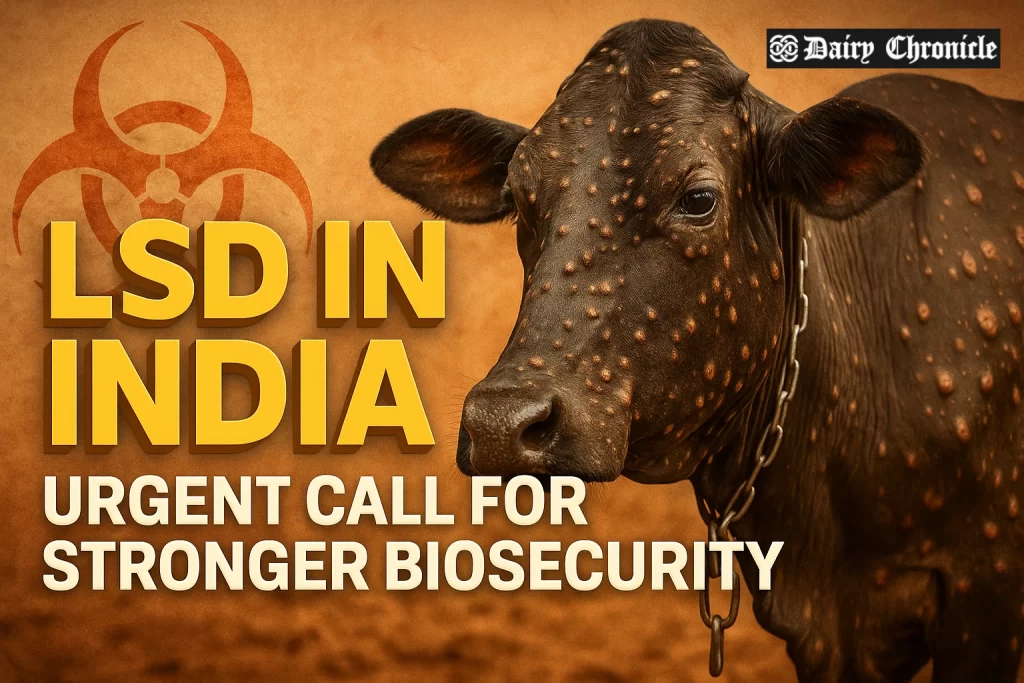
The Indian dairy sector continues to experience Lumpy Skin Disease (LSD) and Foot-and-Mouth Disease (FMD) alongside cattle biosecurity issues raised by these diseases. In addition to the financial and production risks, the weak enforcement of cattle laws, absence of traceability, and lack of funds are the reasons that add up.
LSD in India: 5 Biosecurity Gaps
The dairy sector of India, which is the main support of more than 80 million rural households, is being affected by frequent outbreaks of the diseases of cattle, especially LSD in India and Foot-and-Mouth Disease (FMD). These outbreaks revealed that there are many flaws in biosecurity, and they endanger the milk production as well as public health. Despite the fact that India is the largest milk producer in the world, the mismanagement of cattle still presents a major obstacle to the development of sustainable dairy.
Biosecurity Challenges Highlighted by LSD in India
The reappearance of LSD in India very clearly shows the frailties of the system. The specialists in veterinary medicine are referring to several core issues, including among others, the poor enforcement of laws controlling the management of cattle, the lack of a universal tagging system, and the inefficiency of quarantine systems. Besides, even diseases such as Brucellosis and Bovine Tuberculosis make the problem more complicated by lowering productivity and putting a strain on the income of the farmers.
Regional Impact of LSD in India
- Maharashtra (Nagpur): 376 LSD cases with 18 cattle deaths were reported. Vaccination drives were conducted for 1.3 million cattle, but due to the gaps in enforcement, many cattle were left unvaccinated.
- Gujarat: 11 districts reported 355 LSD cases with 8 deaths caused by the disease. Presently milk testing has played a great role in early detection, and hence limiting further outbreaks, but it has also unearthed the requirement of proactive monitoring.
- Punjab: Senior veterinary officers are warning that stray and untagged cattle are the “silent carriers,” and therefore along with vaccination, traceability is a must to be able to stop the spread.
Financial Burden of Quarantine and Control
Quarantine enforcement is underfunded and is always a problem logistically. The budget for district veterinary often is not enough to cover the expenses which can go up to $12,000 (₹10 lakh) per impoundment. In addition to the high costs, some of the risks are the lack of security and that there is no cattle branding system which makes the containment more difficult.
Systemic Failures Beyond LSD in India
The experts are very clear that these outbreaks cannot be considered as isolated incidents, and rather, they should be seen as symptoms of system failure. The predicament of India is a mirror of the inefficiencies in the structural aspect of the country which not only cause problems in disease control but also others. The sustainable solution to these problems is to reform the identification of cattle, be very rigorous with the quarantines and have a strong veterinary infrastructure. If this is not done, then the risk of biosecurity will still be a major factor in the dairy growth and the farmers’ livelihoods will further deteriorate.
FAQ’s
What is Lumpy Skin Disease (LSD)?
Lumpy Skin Disease (LSD) is a viral infection in cattle that causes skin nodules, fever, reduced milk yield, and in severe cases, death.
Why is LSD in India a biosecurity concern?
LSD spreads quickly through insects, stray cattle, and unregulated animal movement. Weak enforcement of cattle laws, lack of traceability, and poor quarantine systems make it harder to control.
Which regions of India are most affected by Lumpy(LSD)?
Lumpy outbreaks were reported in Maharashtra, Gujarat, and Punjab. These regions faced cattle deaths, unvaccinated animals, and the challenge of monitoring stray cattle acting as silent carriers.
What are the main biosecurity gaps exposed by LSD in India?
Experts highlight poor cattle identification, weak quarantine enforcement, underfunded veterinary services, and limited vaccination coverage as the biggest biosecurity gaps in India.
How much does Lumpy(LSD) control cost in India?
Quarantine and control efforts can cost up to ₹10 lakh ($12,000) per district impoundment, but veterinary budgets are often insufficient, making containment difficult.
What is the long-term solution to Lumpy outbreaks in India?
Stronger biosecurity requires universal cattle tagging, better vaccination drives, stricter quarantine systems, and improved veterinary infrastructure to safeguard both animal health and farmer livelihoods.
READ MORE ON