


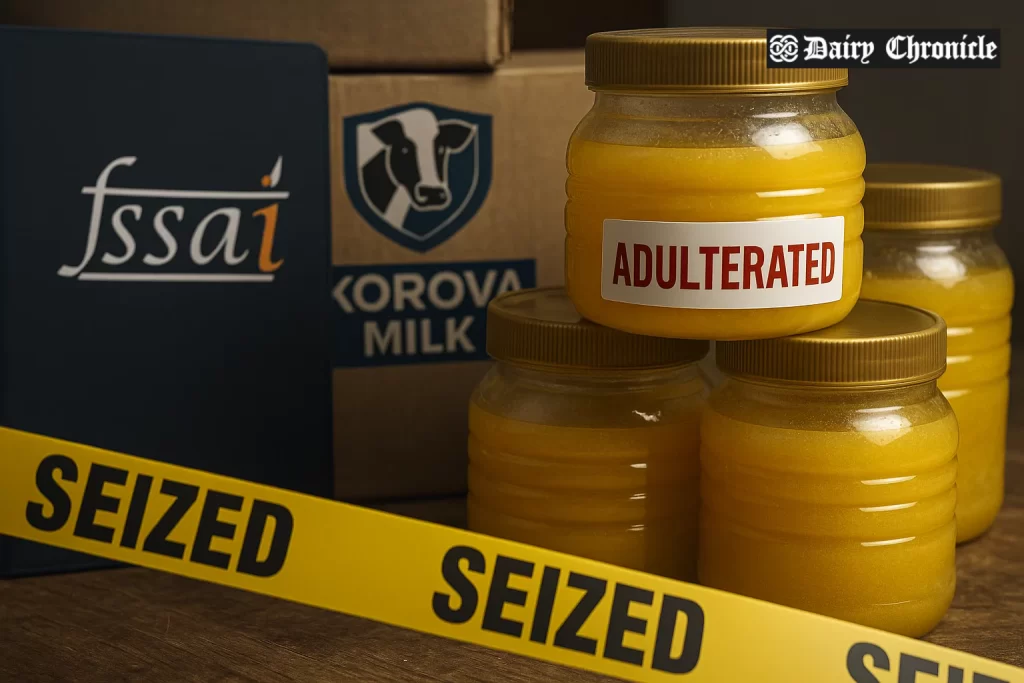
After the laboratory tests indicated that the cows ghee was mixed with vegetable fat, India’s Food Safety and Standards Authority of India (FSSAI) seized ghee worth Rs 35 lakh from a dairy unit based in Rajkot. This incident has led to the imposition of stringent legal measures.
The Food Safety and Standards Authority of India (FSSAI) has confiscated approximately 6,500 kgs of adulterated ghee worth ₹35 lakhs from M/s Korova Milk Product Private Limited, a dairy unit based in Rajkot, Gujarat.
The move was made under the regulator Special Ghee Surveillance Drive which is a major step taken by the country in the fight against food adulteration.
Preliminary examination of the sample, conducted in an FSSAI-certified laboratory, found that the ghee taken was mixed with vegetable fat, which was a direct violation of the Food Safety and Standards (FSS) Regulations, 2011. The operator of the dairy, however, did not react to the report within the specified time period of one month, during which he was allowed to lodge an appeal.
Regulatory Action and Seizure
On 20th of August 2025, during the follow-up inspection, the FSSAI officials conducted an extensive search at the Rajkot dairy unit. All the available stock, comprising raw materials and finished products, was seized, and the officials took fresh samples for further laboratory tests.
With this development, the Central Licensing Authority will be taking steps to file a legal case jurisprudence of the Food Safety and Standards Act, which is a clear indication of the country’s stance against food adulteration.
India’s Dairy Market Under Scrutiny
India is the largest producer and consumer of dairy products globally. Ghee is one of the most consumed products of this whole list. Unfortunately, the India dairy value chain is facing the challenge of adulteration frequently.
Though the market is dominated by the cooperatives and private players, the consumer compliance trust violations and the reputation of Indian dairy products both local and global are at stake. The seizure in Rajkot is a warning that enforcement mechanisms treating the safety of food must be put into place immediately and not be a mere token.
Also Read: Agra’s Wake-Up Call: When Milk Becomes a National Concern
The Economics of Adulteration
Adulteration from a financial point of view is mostly led by the desire to cut down production costs. That is why vegetable fat, which is cheaper than milk fat, is mixed with ghee illegally to make the margin of profit larger. But, they are faced with serious repercussions of which legal penalties, brand damage, and consumer distrust are among the worst that the offenders will experience in the long run and however, they still choose to go that route.
The problem now for Korova Milk Product Private Limited is it is not just the seized stock worth about ₹35 lakh that they have to worry about. There are going to be repercussions that include legal action and reputational damage which may disrupt the company’s activities as well as collaborations in the Indian dairy sector market which is already competitive.
Industry Insight: Need for Strengthened Oversight
The Rajkot case reminds us that quality compliance in India’s dairy sector is a must. The FSSAI’s Special Ghee Surveillance Drive only ensures that the dairies regularly check compliance with the prescribed food safety norms, but, unfortunately, sole enforcement, even if it is continuous, cannot solve deep-rooted issues.
Among the key steps that can reaffirm the dairy industry in India are the following:
- Improved Traceability: Digital means of milk procurement and ghee manufacture tracking can play a huge role in cutting down the chances of adulteration.
- Continuous Vigilance: A larger number of periodic and sudden checks can be a great deterrent to the illegal activities that take place.
- Cooperation within the Industry:The dairy cooperatives and private operators have to be not just reactive but proactive and actively engaged with FSSAI to ensure the transparency of the process.
- Capacity Building: It will be very relevant when the training of the dairy units on regulation and food safety protocols is taken up.
Consumer Confidence at Stake
For the consumers of the Indian dairy industry, none is more important than trust. Ghee, which is generally considered a basic necessity item of both households and festivals, implies not only to nutrition but also to the culture. Instances of adulteration stringently undermine this trust and may even convert the consumers’ loyalty towards the bigger and thus, more established cooperatives such as Amul and Mother Dairy which are the ones that have a very strong compliance framework.
The Rajkot seizure, as such, is not only an isolated incident but a test of India’s ability to uphold global standards of food safety whilst providing support to the smaller farmers who are involved in the dairy economy.
The Road Ahead for FSSAI
FSSAI has once again made it absolutely clear that they will not accept food adulteration under any circumstances and the necessity for safe and unadulterated food is of utmost priority. The dairy sector in India is booming and therefore, the key to success would be the continuous, timely and modernized regulatory system, and the cooperation of all the stakeholders.
The final lab results in the Rajkot case will determine whether or not the legal outcome sets an important benchmark for enforcement. Legal actions such as these accompanied by strengthened compliance can certainly have the effect of discouraging the wrongful practice, while at the same time protecting the interests of consumers and the long-term stability of India’s dairy economy.
FAQ’s
Q1. Why did FSSAI seize ghee from the dairy unit of Rajkot?
The laboratory results showed that the ghee was adulterated with vegetable fat without mentioning the case under the Food Safety and Standards Regulations of India, 2011. Based on these results, the stock was taken away.
Q2. How much is the adulterated ghee that was seized worth of?
Around 6,500 kg of adulterated ghee was seized by FSSAI. The ghee was from a dairy unit in Rajkot and the total value of it is approximately ₹35 lakh.
Q3. What impact does adulteration have on the dairy industry of India?
The adulteration of the dairy industry trust, leads to brand reputation being damaged, regulatory sanctions being imposed, and India’s image in the domestic and international market being at risk.
READ MORE ON
8 Comments
dktxi3
7kmf3n
KxKhUbfMCtSw
lak6an
sphxqu
l43hti
br05k5
rb4cmz