


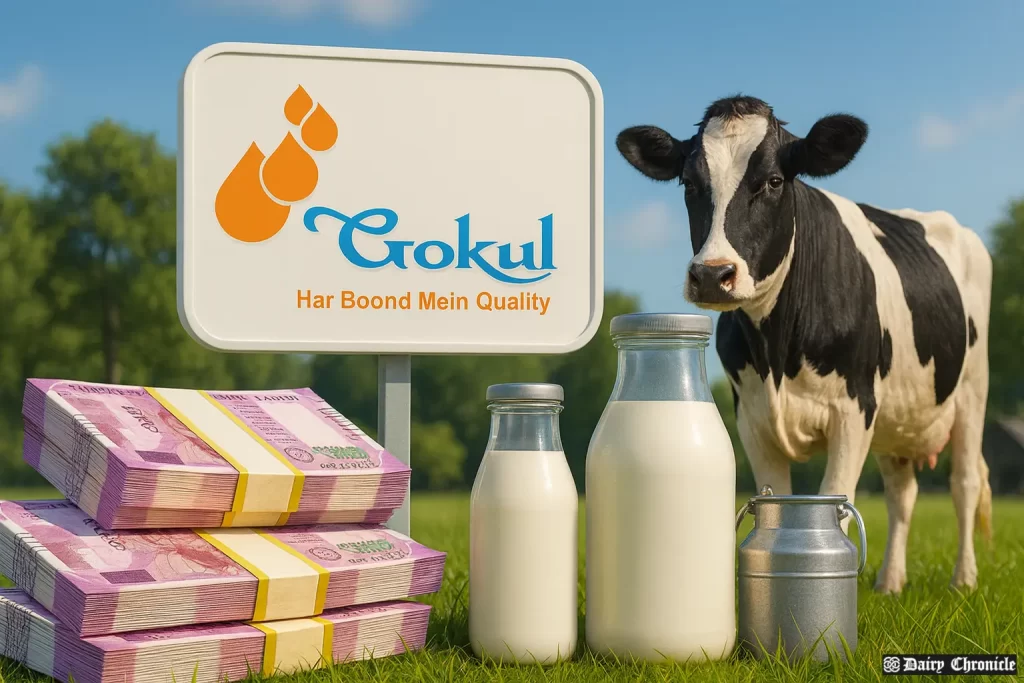
Not only has Gokul Dairy raised the procurement rates by ₹1 per liter for both cow and buffalo milk, but it has also increased the hourly income of milk producers by ₹4-5 crores. At the same time, the cooperative has extended subsidies and eased eligibility conditions to help small dairies maintain supply without any change in retail milk prices.
Gokul Dairy: Cooperative Leader of Western India
Kolhapur Zilla Sahakari Dudh Utpadak Sangharsh Ltd., better known as Gokul Dairy, is one of the most well-known milk cooperatives in Maharashtra. Working on the supply side of India’s rapidly growing dairy ecosystem, Gokul Dairy not only procures and processes milk but also distributes milk and dairy products. The cooperative collects almost 16 lakh liters of milk daily from roughly 7,500 small dairies, and plans to increase the scale to 20 lakh liters per day are already in place.
Following a cooperative model, Gokul Dairy bypasses the middlemen and directly connects with the farmers, thus ensuring that the rural economy receives stable incomes, subsidies, and support for the development of rural infrastructure. Their commercial strategy is a win-win scenario for farmer welfare and consumer affordability, as they maintain stable retail milk prices even when procurement prices soar.
Gokul Dairy Milk Price Increase to Raise Farmer’s Income
As of September 1, 2025, Gokul Dairy has raised the procurement price for both cow and buffalo milk by ₹1 per liter. This move is projected to result in an increased monthly income of ₹4–5 crore for the dairy farmers of the Kolhapur district.
The escalation of prices happens to come at a critical moment when producers suffer from rising input costs, feed for cattle, and the like. There is no doubt that Gokul Dairy is playing a good role in the delivery system, as it is raising procurement prices while keeping retail prices steady. This system guarantees that the benefits directly reach the farmers, but at the same time, consumers do not take the burden.
Small dairy farmers whose main source of income is dairy products will definitely benefit from this rise.
Additional Subsidies for Small Dairies
In order to increase her support base, Gokul Dairy has also done likewise with her subsidy program by extending it to the smaller dairies.
- Building and Employee Subsidy: Depending on the quantity of milk collected, the amount of the subsidy and the number of employees were increased by ₹8,000–₹10,000. The increased grant can be used in small dairies for rising construction and labor costs.
- Relaxation of Cattle-Shed Subsidy: In the past, only owners of dairy farms with at least five animals could apply for cattle-shed subsidies. The number of animals on the farm has now been reduced to four; thus, the help has been extended to the greater number of small-scale dairy animals.
These steps mean a lot for such dairies that are working with very tight profit margins. Gokul achieved a breakthrough in this regard by relaxing eligibility norms and increasing grants, resulting in more rural households having financial assistance to upgrade infrastructure, hire employees, and carry out business expansion activities.
No Change in Retail Milk Prices
Though procurement costs have gone up, milk prices remain the same in the retail market. Gokul Dairy has chosen to do this in order to make sure that the financial needs of farmers are met while at the same time consumers do not have to spend that much. Through the effective management of the supply chain and the support of the cooperative, the organization is thus ensuring that consumers do not have to bear the extra costs that come in the form of inflation while at the same time sustaining the welfare of producers.
Scaling Milk Collection to 20 Lakh Litres
At present, Gokul Dairy collects milk of about 16 lakh liters every day from various farmers. The cooperative plans to increase the collection by 4 lakh liters and aims to reach 20 lakh liters per day.
Apart from that, the dairy also aims at having well-organized and effective institutional systems, setting up proper infrastructure, and assuring continuous participation of farmers. This is a clever move by Gokul Dairy to increase its market share, to take advantage of better economies of scale, and to become one of the first cooperatives in the Indian dairy sector by extending its customer base.
Financial Significance of Gokul Dairy’s Strategy
When combined, the effects of higher procurement prices and expanded subsidies can lead to important financial outcomes:
- Farmer Incomes: As an outcome, an additional ₹4–5 crore is expected every month; thus, the cash flows of smallholder farmers in Kolhapur should improve, whereby these farmers will have more working capital. And in this way, dairy farmers will also be able to take up health, feed, and infrastructure-related areas of their farms.
- Rural Employment: The enormous government assistance for auxiliary staff will pay the dairies the necessary wages to attract and keep employees and at the same time create new jobs in rural areas.
- Supply Chain Stability: Since Gokul Dairy is supporting their farmers financially, their procurement network is strengthened; thus, production and retail operations will be staffed well without problems of stagnation.
- Consumer Protection: Milk prices in retail that are kept at steady levels are one of the tools used to protect people living in cities and rural areas from fluctuations in prices, aka investments in demand and affordability of the product.
Strengthening Cooperative Resilience
The Indian dairy sector has to constantly deal with a number of issues, such as increased input costs, intense competition, and unpredictable markets. Gokul Dairy’s recent initiatives exemplify a two-pronged approach: safeguarding farmer incomes and, at the same time, maintaining retail price stability.
Also Read: Rashtriya Gokul Mission and NLM Drive Dairy Development in India
Through this, a certain level of faith from the 7,500 small dairies the group has, consisting of member-owners, is not jeopardized in the long run, but, on the contrary, the co-op’s resilience in a very competitive market is also increased. By allowing freer access to subsidies and being more daring in setting growth milk collection targets, Gokul Dairy is strategically committing itself to becoming a model of rural development implemented by the cooperative sector.
Future Outlook
On one hand, Gokul Dairy has confirmed being a farmer-first co-operative through an equilibrated policy of procurement price hikes and expanded subsidies, while, on the other hand, by making the decision to keep retail prices stable, it has demonstrated a commitment to producers as well as consumers.
According to the cooperative, it is a measure to secure rural livelihoods, bring in more farmer participation, and maintain India’s vibrant dairy revolution as it moves closer to its 20 lakh liter per day collection target.
FAQ’s
How does Gokul Dairy support small dairy farmers?
Gokul Dairy follows a cooperative model that bypasses middlemen and connects directly with farmers. It provides subsidies, easier eligibility conditions, and infrastructure support, ensuring that small dairies can sustain their milk supply.
What scale of operations does Gokul Dairy manage?
Currently, Gokul Dairy procures about 16 lakh liters of milk daily from nearly 7,500 small dairies across Maharashtra. Plans are already underway to expand this capacity to 20 lakh liters per day in the near future.
What role does Gokul Dairy play in rural development?
Beyond milk procurement, Gokul Dairy invests in rural infrastructure development, including cold storage, transport networks, and subsidy schemes. These efforts strengthen the local economy and empower small farmers.
How does the price hike help Gokul Dairy compete with private dairies?
By offering higher procurement prices and subsidies while keeping retail rates stable, Gokul Dairy strengthens its competitive edge against private dairies, ensuring both farmer loyalty and a consistent milk supply.
READ MORE ON