


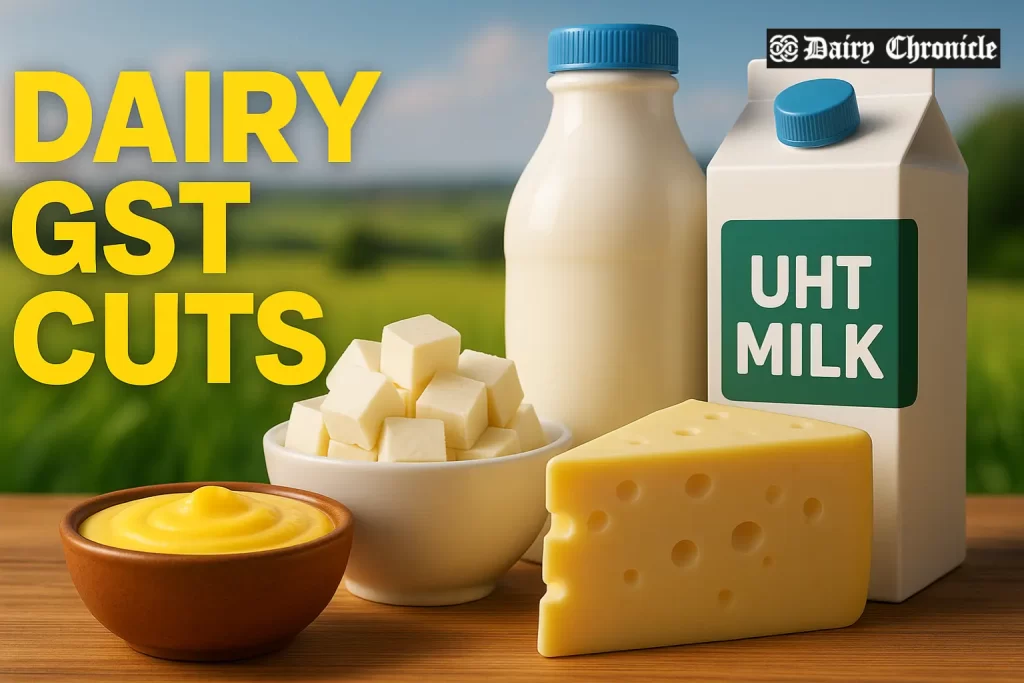
India’s new Dairy GST reforms cut rates on ghee, paneer, and UHT milk, driving consumer savings and boosting farmer incomes. Value-added segments are set to grow.
Dairy GST Cuts Drive Consumer Savings in India
India’s Dairy GST changes have lowered the tax rates on numerous dairy products and thus created savings for buyers and also improved the agricultural economic situation across the country. From now on, Ghee, cheese, and ice cream (excluding chocolate flavors) are given a reduced GST rate of 5%, while UHT milk, paneer, and chhanna are completely exempt from GST. Due to these alterations, up to ₹42 per kilogram of ghee can be saved, with packaged paneer and UHT milk becoming ₹3-4 cheaper for consumers.
Such an act goes hand-in-hand with the government’s broader budget strategy to encourage the production of dairy value-added products, domestic market formalization, and farmer support, particularly smallholders and women in rural India.
Strong Impact Across Value-Added Dairy
The GST cuts in the dairy sector have a major influence on the different categories of milk products, as the idea of affordability and thus the demand intensifies:
- Ghee: The ₹3.48 trillion market witnesses the drop of the price of the product by around 6–7%, which in turn leads the household consumption to increase and elevates the position of the organized players as they get strengthened against the edible oil alternatives.
- Paneer: There is no more GST on the ₹648 billion market, so the consumers who previously bought loose, unbranded paneer will most likely shift to packaged and hygienic alternatives.
- UHT Milk: Considering 1.31 billion liters are consumed in 2024, the exemption from GST is a very good support for tier-2/3 markets and e-commerce channels, resulting in a rise of formal trade.
- Cheese: The segment worth ₹108–120 billion faces reduced production costs, which results in the encouragement of household usage as well as HORECA (hotel, restaurant, café) adoption.
- Ice Cream: The ₹268 billion market is positively affected by the 5% rate and thus the regional players and season consumption get revitalized.
Experts foresee that the price-sensitive value-added categories will immensely benefit from this move and will thus experience a significant increase in demand within the next 6-12 months provided that input costs remain stable.
Consumer Benefits and Price Pass-Through
Consumers are expected to enjoy substantial savings:
| Product | Base Price | Old GST | New GST | Savings |
| Ghee (1 kg) | ₹600 | ₹72 | ₹30 | ₹42 (~7%) |
| Cheese (200 g) | ₹120 | ₹14.4 | ₹6 | ₹8.4 (~7%) |
| UHT Milk (1 L) | ₹70 | ₹3.5 | ₹0 | ₹3.5 (~5%) |
| Ice Cream (500 ml) | ₹140 | ₹25.2 | ₹7 | ₹18.2 |
Source: GST
The government has underlined that the decreases are expected to be completely handed over to consumers. Mechanisms for enforcement will guarantee that there is compliance with the law, thus ensuring that businesses do not take tax benefits for themselves and at the same time support the loyalty of Dairy GST changes.
Industry Outlook and Compliance Challenges
On the one hand, the consumers and farmers profit from the GST cuts; on the other, companies face some difficulties related to Input Tax Credit (ITC). As there is no ITC for products like UHT milk and paneer which are completely exempt, manufacturers may have to pay more to produce these goods. In order not to lose the margin but, at the same time, ensure that the savings are passed on to the end-users, companies will have to allocate ITC very carefully in accordance with GST Rule 17 and Section 16(4).
Compliance strategies may include:
- Adjusting product pricing and packaging
- Modification and optimization of supply chains
- Complying with the requirements of GST 2.0 subsidy
According to industry experts, the best-organized dairy producers have the maximum ability to take advantage of these changes and to increase their market share, which they are not able to do since they are the informal players.
Boost for Farmers and Value Chains
Dairy products like milk, ghee, paneer, and others will probably be bought in more formal ways through the application of GST cuts. The result will be higher and more reliable farmgate prices for dairy farmers. The analysts say that Dairy GST reforms could be a great help to achieve the government goals like the effort to double farmer incomes and reduce market volatility for small farmers besides the obvious climate change advantages.
By the visibility of the demand for processed dairy products being increased, farmers who send raw milk to organized processors are made to have a steady source of income, are less dependent on the informal market, and are better integrated into India’s value-added dairy ecosystem.
Future Prospects
According to market research and demand forecasting, the growth in value-added dairy products–ghee, paneer, cheese, and ice cream– will be accelerated by the low GST rates. The price sensitivity of these products is very high that is why the cost reductions induce a very strong positive demand volume response which can range from 1 to 2 percentage points in FY26.
Moreover, experts acknowledge that zero-rating of ordinary dairy staples such as UHT milk and paneer can go a long way in assuring safe, packaged product consumption that ultimately benefits consumers’ health as well as food traceability.
To sum it all, India’s Dairy GST reforms represent a win-win situation where immediate consumer savings, enhanced value-added dairy consumption, and long-term support for farmers and organized dairy players result from balanced fiscal stimulus. Through the effectiveness of this policy, both demand and supply chains across the Indian dairy sector are expected to be uplifted.
FAQ’s
What is the GST on UHT milk in India?
UHT milk is now completely exempt from GST, providing savings of about ₹3.5 per liter for consumers.
How much GST is applied on cheese under the new rules?
Cheese now carries a 5% GST rate, down from 12%, cutting consumer costs by about 7% per pack.
What is the GST rate on ice cream in India?
Ice cream (except chocolate flavors) is now taxed at 5% GST, down from 18%, giving savings of about ₹18 per 500 ml tub.
How do GST cuts on dairy help farmers?
By making value-added dairy products more affordable, the cuts encourage demand, benefiting smallholder farmers and cooperatives through higher sales volumes.
What challenges do companies face after dairy GST cuts?
Since paneer and UHT milk are now GST-exempt, companies cannot claim Input Tax Credit (ITC) on related costs. This forces manufacturers to manage production expenses carefully while still passing savings on to consumers.