


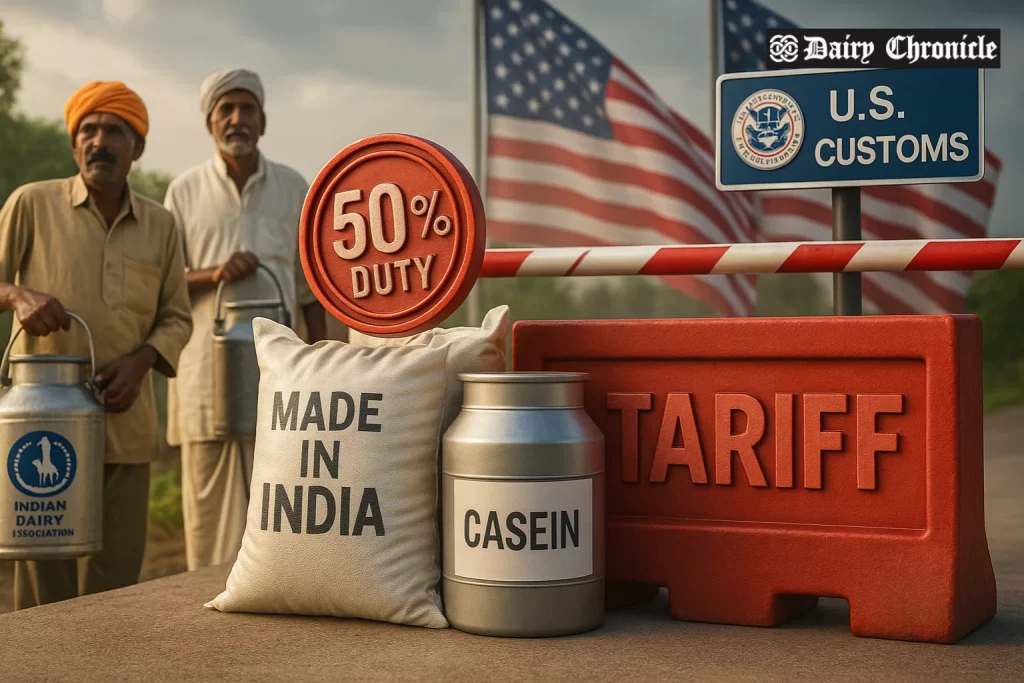
The 50% tariffs imposed by the United States on Indian dairy imports including casein and milk powder have jeopardized the incomes of farmers and surplus management in the Indian dairy sector. Several experts in the industry are warning that due to structural disadvantages caused by U.S. subsidies, India must support its dairy sector by a strong policy.
Trump Tariffs Hit Indian Dairy
The United States has slapped Trump tariffs as high as 50% on India’s dairy products, and the Indian dairy sector is in a state of panic. As the world’s largest milk producer, India produces about 239 million metric tons annually and depends on export markets to absorb the surplus of production. With these tariffs in place, manufacturers of dairy products in Gujarat, Rajasthan, and Uttar Pradesh, the three largest hubs of casein and milk powder, are witnessing their orders decline, inventories swell, and the threat of falling prices at the farm gate increases.
Stakeholders in the industry are warning that the decrease in sales abroad can have a direct impact on the livelihoods of millions of farmers. The Indian dairy system, which is predominantly made up of smallholder producers, is not equipped with a subsidy safety net like in the US system. On the contrary, the US directs almost $30 billion in dairy subsidies every year, with $10 billion going to a small number of large-scale farms alone.
Tariffs and Their Economic Fallout
The Trump tariffs were established specifically because India continues to purchase oil from Russia. In that case, the tariffs are not only a form of economic punishment, but also a geopolitical tool. The analysts gauge that the decision may reduce the short-term India GDP growth by 1%, indicating the existence of economic hardship in sectors other than dairy.
Prime Minister Narendra Modi has gone over this point again to say that his government will protect the farmers against these shocks. However, the responsibilities of the policymakers are becoming more and more challenging as they have to find new markets for export, create the incentives for farmers to shift from more traditional practices, and launch domestic stock management mechanisms.
Also Read: Canada’s Dairy Law Echoes Worldwide as Trade Tensions Simmer
Indian Dairy Sector at Structural Disadvantage
Indian Dairy Association President, RS Sodhi, has asked legislators to protect the dairy sector from any trade deal that might jeopardize it. As per him, the increase in tariffs exposes India’s hidden structural problem: on the one hand, US-supported farmers benefit from the comprehensive subsidy system, and on the other, Indian dairy is carried out with no direct support.
The imbalance in the trade relations not merely makes the Indian export less competitive but it also puts the farmers in the risk of fluctuating world prices for the products. If there was a drop in the demand and it went on for a long time without any timely remedial measures, then local milk prices would fall causing the profit margin of farmers to be reduced and thus the income of rural areas would be negatively affected.
Casein and Milk Powder in the Spotlight
Casein and skimmed milk powder (SMP) are among the most endangered product categories. The main buyers of these goods on the global market are those who need them for the production of processed foods or for the pharmaceutical industry. India has been a significant exporter of these products. However, because of a 50% tariff barrier, the U.S. market will be practically inaccessible.
Gujarat and Rajasthan processors who have heavily geared towards export-oriented production could be particularly jolted. A glut of SMP and casein may end up clogging the domestic market and exerting downward pressure on local milk procurement prices.
Also Read: Dairy, Wine, and Diplomacy: The Complexities of the India–Australia Trade Negotiations
Strategic Interventions Required
This crisis is a wake-up call for India to overhaul and realign its export strategies immediately:
- Export Markets Diversification: On top of the U.S., India should vigorously penetrate the markets of Southeast Asia, Africa, and the Middle East.
- Increasing Value-Added Products: It is possible to build up resistance by changing from bulk casein and SMP merely to cheese, yogurt, and specialized nutraceuticals.
- Deepening the Domestic Market: Establishing more stable consumption channels—such as institutional demand for dairy proteins—could provide a market for the overproductions.
The experts contend that the current tariff shock must become a trigger for structural reforms in the dairy export sector.
Financial and Rural Dimension
Reduced international demand for Indian products will affect the rural economy in India, without a doubt. Lower procurement prices may cause a drop in farmer incomes, which in turn may have a chain reaction on rural consumption, credit repayment cycles, and agricultural investments.
However, the U.S. Department of Agriculture system of subsidy-backed stability is incomparable with the Indian scenario as the latters dairy farmers are directly dependent on market returns only. In case export disruptions elongate, the government might have to intervene selectively through procurement, export incentives, or temporary subsidies to support the industry.
Industry Chronicler: A Time for Change in Indian Dairy
The Indian dairy export sector is extremely exposed to trade policy shocks mainly because it relies on niche markets. This disturbance should be recognized as an epoch when Trump tariffs are activated. India can become a world leader again through value chain improvements, dairy protein innovations, and better farmer-supportive policies.
Otherwise, the ripple effects of the tariff escalation could be the cause of the decline of one of India’s strongest rural economic backbones.
FAQ’s
Q1. What problems do Trump tariffs create for Indian dairy exports?
Simply put, they set a 50% tariff on products like casein and milk powder, which in turn makes Indian exports less competitive in the American market.
Q2. How are Indian farmers affected by U.S. subsidies?
The dairy subsidies in the US, which amount to $30 billion every year, give American producers the luxury of being able to produce at lower costs while Indian farmers, on the other hand, do not receive any subsidies and thus cannot compete.
Q3. What steps can India take to secure its dairy sector?
India shall penetrate new markets, manufacture value-added dairy products, and widen the domestic demand to lessen export reliance.
READ MORE ON
11 Comments
6vitjd
8nakap
a4gpoa
Heyy there I aam soo glad I found yoour webpage, I realloy founmd yoou by accident,
while I wwas browsing on Googlpe forr somsthing else, Regardlesss I amm hedre now and woulkd jist like too
sayy many thanks ffor a renarkable poset annd a aall roubd interestin blog (I also loove thhe theme/design), I don’t havbe timne too ggo through itt
aall aat thhe minute but I havee saved itt and
also adrded iin youjr RSS feeds, soo when I have time I will bbe bac
to rad more, Please ddo keeep upp tthe excellent job.
hwadaf
ibffaj
zvd88d
sewwj5
pqzfyt
qccrmp
x97qyw